

MindsNet field notes / The attention machine
Every psychology book is being read. Just not for your growth.
Humanity spent a century learning how minds work: habits, rewards, memory, motivation. That library is being applied every single day, at scale, with billions in funding. Just not by you, and not for you.
By MindsNetJuly 18, 20267 min read
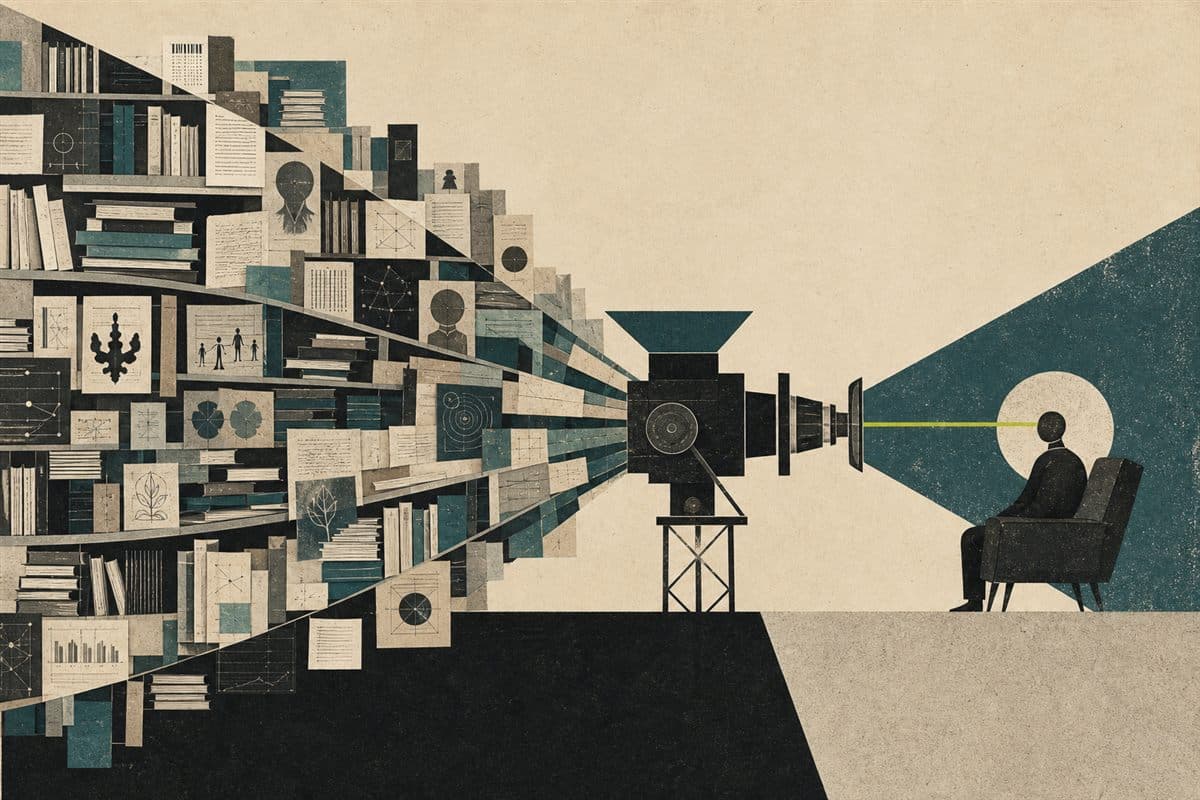
Think about what psychology was supposed to be for. Understanding yourself. Breaking bad habits, building good ones. Knowing why you procrastinate, what actually motivates you, how your memory works. A century of research, from Pavlov to Kahneman, built so people could live better.
Now ask who actually reads that research today, carefully, professionally, every day. It is not mostly therapists. It is product teams. Growth teams. Recommendation engineers. The best-funded application of behavioral psychology in human history is the engineering of your scroll.
the asymmetry
It was never a fair fight
When you open a feed, you are not using a neutral tool. You are stepping into a system built by people who studied the same psychology books you never got around to reading, and who then ran millions of experiments on people like you to sharpen what those books taught them. Every color, every notification sound, every pull-to-refresh gesture has been tested against your reflexes.
The thought process was: how do we consume as much of your time and conscious attention as possible? It's exploiting a vulnerability in human psychology.
That is not a critic talking. That is one of the people who built it, describing the design goal in plain words. The vulnerability he means is not stupidity. It is the ordinary wiring every human shares: we respond to unpredictable rewards, we care what others think of us, and we reach for our phones when we feel any small discomfort.
0
average phone touches per day, measured by the research firm dscout
0 min
average time spent on social platforms per day, across global studies
0 sec
average unbroken attention on any one screen, per attention researcher Gloria Mark
the library
The exact ideas being used on you
None of this is secret. The playbook is built from famous, public research. The difference is who operationalized it.
Variable rewards, from B.F. Skinner
Skinner showed that unpredictable rewards create the most persistent behavior. A slot machine uses it. So does every feed refresh: sometimes something great, usually nothing, so you pull again.
Social approval, from decades of social psychology
Humans are wired to monitor their standing in the group. Like counts and follower numbers turn that ancient wiring into a scoreboard you check compulsively.
Loss aversion, from Kahneman and Tversky
Losing something feels roughly twice as bad as gaining it feels good. Streaks, expiring stories, and 'last chance' badges all manufacture things for you to be afraid of losing.
The habit loop, from behavioral science
Cue, routine, reward. Product teams call it the hook model and design for it openly: an internal trigger (boredom, loneliness), a tiny action (open the app), a variable reward (the feed), and an investment (your posts, your streaks) that pulls you back.
the flip
The same books, pointed the other way
Here is the part that should make you angry, and then hopeful. Every one of those mechanisms works in both directions. Variable rewards can make learning addictive instead of scrolling. Social wiring can bond you to people building the same thing you are, instead of to an audience you perform for. Habit loops can carry a curiosity for years instead of a streak for weeks.
The knowledge was never the problem. The direction was. Psychology aimed at you extracts. Psychology aimed with you compounds. The entire point of MindsNet is to be the second kind of company: the same understanding of how minds work, used to grow the person instead of the session time.
Common questions
Is it really true that apps are designed using psychology?
Yes, and openly. Persuasive design is a documented field: Stanford ran a famous persuasive technology lab, the hook model is taught from bestselling books, and executives like Sean Parker have described exploiting psychological vulnerabilities as the explicit design goal.
Does knowing about these tricks make me immune to them?
No. Awareness helps, but these mechanisms target reflexes, not reasoning, which is why willpower alone rarely wins. What works is changing the environment: removing the triggers, or using tools that point the same psychology at your goals instead.
How can I use psychology for my own growth instead?
Start with the same loop the apps use, pointed at something you choose. Pick a real interest, make starting tiny, let progress be your variable reward, and put your investment somewhere you own. That is the model MindsNet products like Fields and S.A.I. are built around.